Red vs Green Kratom begins long before the final label is printed on a package. A picker moves through a humid Southeast Asian grove just after sunrise. On one branch, the leaves look deeper and older, with veins that have shifted toward red. On the other hand, the leaves are still vividly green, fresher in appearance, and less altered by time or handling. By the time both batches are dried, ground, and packed, they may sit side by side under two familiar labels—Red and Green.
That simple contrast looks obvious on a shelf, yet the real story starts earlier: in leaf maturity, in the way the harvest is handled, and in how drying conditions reshape color long before the powder reaches a bag.
Red And Green Kratom Are Not Two Different Plants
Red and Green Kratom are not separate species. They both come from Mitragyna speciosa, and research indicates that different vein colors can occur on the same tree. Peer-reviewed work supports the broader point that color labels fall within a single plant system whose chemistry varies with genetics, season, geography, maturity, and postharvest handling.
That matters because many articles present color labels as fixed, natural categories, whereas the research literature presents a more layered picture. In a Scientific Reports analysis of 53 commercial Kratom products, researchers found two distinct chemotypes, underscoring that commercial naming does not always map neatly onto a single uniform chemical profile.
Red vs Green Kratom: Major Differences To Know
The main difference between Red Kratom vs Green Kratom comes down to leaf maturity, postharvest processing, drying conditions, and final color development. Red is generally associated with more mature leaves and darker finishing methods, while Green is more often linked to semi-mature leaves and lower-intervention drying.
The first major difference: leaf maturity
One of the most commonly cited differences between Red and Green Kratom is the harvest stage. Red is often described as coming from more mature leaves, while Green is commonly linked to semi-mature leaves. A 2023 study indexed in PubMed provides useful scientific context: mitragynine was predominant in mature leaves, whereas juvenile leaves accumulated higher levels of other alkaloids, such as corynantheidine and speciociliatine. In other words, maturity does not just change appearance; it can shift the leaf’s chemical balance.
This helps explain why maturity remains central to the Red vs Green Kratom discussion. Even before drying begins, the leaf is already changing as it develops. So when people describe Red as more mature and Green as less mature, they are pointing to a real harvest-stage distinction, even if that distinction alone does not tell the whole story.
The second major difference: postharvest processing
Processing is where the gap between Red and Green often becomes more visible. Red Kratom is often described as undergoing longer or more transformative drying, sometimes outdoors or with added fermentation, while Green Kratom is usually described as more lightly processed, so its brighter color stays intact.
Recent plant-science research strongly reinforces the importance of postharvest handling. In a 2025 Frontiers in Plant Science study, researchers tested multiple withering durations and drying temperatures, including 25°C, 40°C, 60°C, and 80°C. They found that withering significantly increased mitragynine concentration by 14–65% in one cultivar and 3–8% in another. They also found that leaves dried at 25°C had overall mitragynine concentrations 3–26% higher than leaves dried at 60°C.
Those figures are especially useful because they show that processing is not just cosmetic. It can measurably alter the final alkaloid picture. That makes drying and withering more than background steps; they are part of what distinguishes the Red and Green categories.
Drying style and color development
Green Kratom is usually associated with lower-intervention drying meant to preserve a brighter green tone. Red Kratom, by contrast, is often associated with methods that darken the material, whether through sun exposure, longer drying, fermentation, or warmer postharvest conditions.
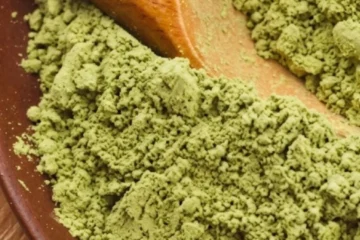
The 2025 Alkaloid Biosynthesis paper makes this point especially clearly: when leaves were dried immediately without withering, key alkaloids such as mitragynine, speciogynine, and paynantheine were similar in leaves dried at 25°C and 60°C, yet the powder color differed markedly. The 60°C samples showed a reddish hue, while the 25°C samples retained a green color.
The authors concluded that powder color does not necessarily correlate with alkaloid composition and may instead reflect the postharvest environment.
Vein color versus powder color
Another useful distinction is between the color of a leaf vein and that of the finished powder. In commercial language, “Red” and “Green” often sound like natural, stable traits. In practice, the finished powder’s color can be shaped by both the harvested leaf and what happens after harvest.
Scientific literature shows that processing conditions alone can shift the visual appearance from greener to redder tones.
So when comparing Red vs Green Kratom, it is more accurate to think in layers: leaf maturity, vein appearance, withering, drying temperature, airflow, and time all contribute to the final presentation.
Chemistry: Why the difference is not simple
Kratom contains a complex alkaloid matrix rather than one single defining compound. Reviews published in 2019, 2020, and later years report that Mitragyna speciosa contains more than 40 alkaloids, while a 2023 study identified over 50 monoterpene indole and oxindole alkaloids in the leaves. That alone shows why Red vs Green Kratom cannot be reduced to one universal formula.
Field data from Thailand adds more context:
- In one PubMed study, researchers sampled 134 trees in one subdistrict and found 56% green-veined and 44% red-veined plants.
- In a broader national sampling set of 611 samples, 57% were green-veined, and 29% were red-veined, with the rest falling into smaller categories.
- The same study also reported that production of key alkaloids remained consistent within red- and green-veined groups during each sampling period.
Green vs Red Kratom: A Simple Side-By-Side Comparison
| Feature | Red Kratom | Green Kratom |
| Leaf maturity | Typically associated with more mature leaves | Typically linked to semi-mature leaves |
| Harvest stage | Later-stage leaves with deeper coloration | Earlier-stage leaves with brighter appearance |
| Postharvest processing | Often involves longer drying or additional steps such as extended exposure or fermentation-style handling | Usually involves lighter processing to maintain original leaf characteristics |
| Drying conditions | May include longer durations or warmer temperatures that contribute to darker tones | Often dried under more controlled or lower-temperature conditions to retain greener color |
| Final powder color | Generally darker, ranging from deep green to reddish-brown hues | Typically lighter, with a more vibrant green appearance |
| Color development factor | Influenced heavily by oxidation, drying time, and environmental exposure | Influenced by minimal oxidation and shorter drying cycles |
| Vein vs powder relationship | Vein color may not directly match final powder due to processing changes | Powder color often stays closer to original leaf appearance |
| Processing impact on composition | Extended processing may alter alkaloid balance depending on conditions | Gentler processing may retain more of the leaf’s original chemical structure |
| Consistency across batches | Can vary depending on drying method and environmental factors | Can vary based on harvest timing and drying precision |
| Key distinguishing factor | A combination of maturity + longer or more transformative processing | Combination of earlier harvest + lower-intervention drying |
Conclusion: Red vs Green Kratom Differences
Red vs Green Kratom is best understood as a comparison of harvest stage and postharvest processing rather than a clash between two entirely different plants. Red is generally associated with more mature leaves and darker finishing methods, while Green is more often tied to semi-mature leaves and lower-intervention drying that keeps the material visibly greener.
At the same time, peer-reviewed studies show that color is not a perfect shorthand for chemistry, because alkaloid composition also shifts with cultivar, season, geography, withering, and drying temperature.
Once those pieces are placed together, the comparison becomes much clearer: the label on the package is only the final chapter of a much longer leaf-to-powder story, isn’t it?