Yellow Thai Kratom is a distinct strain within the broader category of Thai Kratom varieties, recognized for its unique post-harvest processing method and balanced alkaloid composition. It is positioned between green and red strains based on how the leaves are handled after harvesting.
This guide presents a detailed breakdown of Yellow Thai Kratom, including its origin, processing steps, Yellow Kratom classification, available forms, and comparisons with other Thai strains. It also outlines key factors to consider when evaluating product quality and sourcing transparency in the current market.
| 📌 Quick Definition: Yellow Thai Kratom Explained Yellow Thai Kratom is a Thai Kratom strain made from Mitragyna speciosa leaves that undergo a post-harvest sunlight fermentation process for about two days. This processing method places it between green and red Thai strains in terms of classification and alkaloid profile. |
What Is Yellow Thai Kratom?
Yellow Thai Kratom comes from the Mitragyna speciosa tree. It grows in Thailand’s tropical forests, where the climate and soil produce alkaloid-dense leaves.
The name tells you two things: the processing color (yellow) and the region (Thai). Both matter when identifying this strain.
The Mitragyna Speciosa Plant
Kratom trees can grow up to 25 meters tall. The leaves contain over 54 active alkaloids. Thai Kratom trees have historically been regarded as some of the most alkaloid-rich due to the unique growing conditions in Southeast Asia.
What Makes It Yellow?
The color refers to the vein color of the leaf after processing — not the color of the raw leaf itself. All Kratom leaves look similar on the tree.
The yellow color develops during post-harvest processing. This is caused by a fermentation step where leaves are exposed to sunlight for a set period. Fermentation alters the alkaloid structure of the leaf.
Read More: A Complete Guide To Yellow Kratom
How Is Yellow Thai Kratom Made
The manufacturing process is what separates yellow-veined strains from other colors. Here is a step-by-step breakdown:
- Leaves are harvested from mature Kratom trees in Thailand
- Leaves are laid out and exposed to sunlight for approximately two days
- Sunlight exposure triggers fermentation, converting alkaloids
- Leaves are dried and ground into a fine powder
- Powder is packaged as Yellow Thai Kratom powder or filled into capsules
The two-day fermentation window is the defining factor. It is shorter than what Red strains undergo (typically 3 days) and longer than what Green strains undergo (which skip fermentation entirely).
Available Forms of Yellow Thai Kratom
- Loose powder (bulk bags of various sizes)
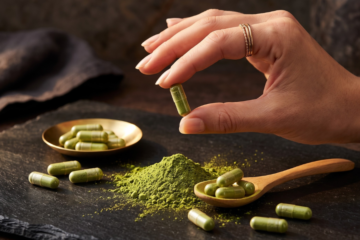
- Capsules (pre-measured powder in gel shells)
Quick Insight: Powder is the most affordable and versatile form. Capsules are convenient for portability and accurate measurement.
Yellow Thai Kratom Powder
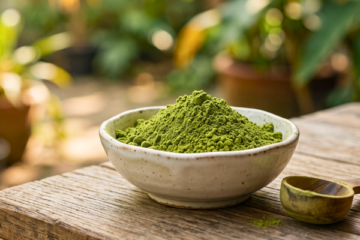
Yellow Thai Kratom Powder is the most common form of this strain that is sold in. It is produced by grinding dried, fermented leaves into a fine powder.
Visual Characteristics
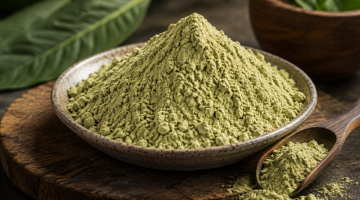
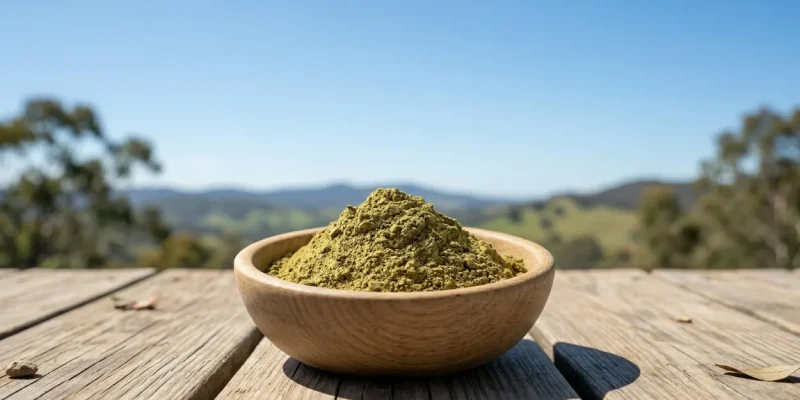
High-quality Yellow Thai Kratom powder has a greenish-yellow or olive-green hue. The exact shade can vary slightly depending on harvest timing, fermentation length, and drying conditions.
Powders that appear unusually bright or very dark may indicate additives, improper processing, or poor-quality leaf material. A neutral, earthy color is expected for a standard batch.
Physical Characteristics
Well-processed Yellow Thai Kratom powder is fine and consistent in particle size — free of lumps, coarse granules, or visible debris. Any inconsistency in particle size may point to insufficient milling.
The natural odor is mild and earthy with a slight bitterness. This is consistent across all Kratom powders and is not, on its own, an indicator of quality variation.
How Yellow Thai Kratom Powder Is Packaged
- Loose bulk bags — available in various weights (50g, 100g, 250g, 500g, 1kg)
- Resealable mylar pouches — commonly used for moisture and light protection
- Labeled with batch number, net weight, strain name, and country of origin
Yellow Thai Kratom Capsules
Yellow Thai Kratom capsules contain the same fermented leaf powder as the loose powder form. The difference is the delivery format — the powder is pre-measured and enclosed in gel capsules.
What Are The Capsules Made Of?
Capsules are typically made from either gelatin or plant-based cellulose (vegetarian-friendly). Each capsule shell is filled with a set amount of Yellow Thai Kratom powder, making it an easy and convenient option.
Capsule Labeling Standards
AKA GMP-compliant capsule products are labeled with the following information:
- Strain name (Yellow Thai Kratom)
- Capsule count and net weight
- Milligrams of powder per capsule
- Lot or batch number
- Country of origin
Powder vs Capsules: Key Differences
| Factor | Yellow Thai Powder | Yellow Thai Capsules |
| Format | Loose, fine powder | Pre-filled gel shells |
| Portability | Requires a container or bag | Easy to carry; no prep needed |
| Measurement | Requires a scale | Pre-measured per capsule |
| Cost | Generally lower per gram | Slightly higher per gram |
| Shelf Life | Equal when stored correctly | Equal when stored correctly |
| Availability | Widely available in bulk | Available in standard counts |
Also Read: Kratom Capsules vs Powder: A Comparison Guide
Yellow Thai Kratom Strain Review: How Does It Compare?
A Yellow Thai Kratom strain review must include comparisons to related strains. Here is a full comparison table to help clarify where Yellow Thai stands:
| Strain | Vein Color | Origin | Processing | Alkaloid Profile |
| Yellow Thai Kratom | Yellow | Thailand | Fermented (2 days) | Balanced mitragynine & 7-OH |
| Green Thai Kratom | Green | Thailand | Sun-dried | High mitragynine |
| Red Thai Kratom | Red | Thailand | Fermented (3 days) | High 7-OH |
| Yellow Maeng Da | Yellow | Thailand/Indonesia | Fermented (2 days) | High-potency alkaloids |
| White Thai Kratom | White | Thailand | Rapid drying | Highest mitragynine |
Yellow Thai vs Green Thai Kratom
Both strains originate in Thailand and come from the same Mitragyna speciosa species. The key differentiator is post-harvest processing.
Green Thai Kratom skips fermentation entirely. Its leaves are sun-dried, which helps preserve higher levels of raw mitragynine. Yellow Thai, by contrast, undergoes a two-day fermentation that partially converts mitragynine into 7-OH.
Alkaloid profile difference: Green Thai has a higher mitragynine-to-7-OH ratio. Yellow Thai has a more balanced ratio due to partial conversion.
Yellow Thai vs Red Thai Kratom
Red Thai Kratom undergoes a longer fermentation, approximately three days, compared to Yellow Thai’s two. Extended fermentation results in greater conversion of mitragynine to 7-OH.
Alkaloid profile difference: Red Thai has a higher concentration of 7-OH. Yellow Thai retains more of the original mitragynine content.
Yellow Thai vs Yellow Maeng Da
Both are yellow strains processed through fermentation. The key distinction is potency. Maeng Da — a Thai term meaning ‘pimp grade’ — refers to selectively cultivated, high-alkaloid trees.
Alkaloid profile difference: Yellow Maeng Da typically has a higher overall alkaloid concentration. Yellow Thai has a more moderate, consistent alkaloid profile.
Yellow Thai is often considered a simpler option than the higher-potency Maeng Da variety.
Yellow Thai vs White Thai Kratom
White Thai Kratom is processed through rapid drying — a method that preserves the highest concentration of mitragynine with minimal 7-OH conversion. It represents the opposite end of the fermentation spectrum from Red Thai.
Alkaloid profile difference: White Thai retains the highest mitragynine levels among Thai strains. Yellow Thai has significantly more 7-OH due to fermentation
How to Read a Yellow Thai Kratom Strain Review
Not all reviews are reliable. Here’s what to look for when reading a Yellow Thai Kratom strain review online:
Look for Lab Testing Information
Credible reviews mention whether the product has been lab-tested. A Certificate of Analysis (COA) from a third-party laboratory confirms alkaloid content, purity, and the absence of contaminants such as heavy metals or mold.
Check the Vendor Credentials
Reviews from American Kratom Association (AKA) Good Manufacturing Practice (GMP)-certified vendors carry more weight. The AKA is a U.S.-based advocacy group that sets industry quality standards.
Look at Batch Consistency
Good reviews note whether quality is consistent across different purchases. Kratom quality can vary between batches. Vendors who publish batch numbers and lab reports show a commitment to consistency.
Avoid Reviews With Unverified Medical Claims
Any review making specific health claims about Kratom should be treated with skepticism. Kratom is not FDA-approved for any medical purpose. Factual, educational reviews are more reliable than reviews that promote specific outcomes.
Yellow Thai Kratom: Sourcing and Supply Chain Transparency
Thailand plays an important role in discussions around Yellow Thai Kratom sourcing because the plant is native to Southeast Asia and has long been associated with cultivation in Thai forest regions. For this strain, sourcing is not just about where the leaf comes from, but also how clearly that origin is documented from cultivation through final packaging.
Thai Cultivation and Regulatory Context
Kratom was restricted in Thailand for decades under the Kratom Act of 1943. That changed in 2021, when Kratom plants and leaves were legalized for personal and medical research. This shift allowed cultivation and export activity to move forward more openly, giving vendors and buyers greater visibility into Thai-origin Kratom supply chains.
Growing Conditions in Thailand
Thai Kratom trees grow in a tropical environment with high humidity, nutrient-rich soil, and steady rainfall. These conditions support strong tree development and are one reason the Thai-origin leaf is often discussed in sourcing conversations. Harvest timing also matters, as mature trees are generally preferred for commercial leaf collection
Vendor Transparency
Clear documentation helps distinguish one product listing from another. Vendors that provide country-of-origin details, batch numbers, and supporting records offer better traceability than listings with limited background information. In the case of Yellow Thai Kratom powder, stronger sourcing transparency often comes from supply chains that connect farms, processors, importers, and final vendors through documented records.
How to Choose Quality Yellow Thai Kratom?
The Kratom market is largely unregulated in the United States. This means product quality varies. Here is a practical guide to identifying quality Yellow Thai Kratom:
| Quality Factor | What To Check |
| Lab Testing | Third-party COA available; tests for alkaloids, heavy metals, pathogens |
| AKA GMP Certification | Vendor listed on AKA’s GMP-qualified vendor registry |
| Origin Transparency | Thailand is listed as the country of origin; batch number available |
| Packaging | Sealed, airtight bags or containers; clear labeling with weight and lot number |
| Return Policy | Vendor offers a satisfaction or quality guarantee |
🏷️ Where To Buy Yellow Thai Kratom?
If you are looking to buy Yellow Thai Kratom, Buy Kratom Bulk USA is a great choice.
Buy Kratom Bulk USA is an AKA GMP-certified vendor specializing in bulk Kratom powder and capsules sourced directly from verified Southeast Asian farms.
Key Details About Buy Kratom Bulk USA
- All products are tested by accredited third-party laboratories
- Certificates of Analysis (COA) are available upon request for every batch
- AKA GMP-certified — audited against industry quality standards
- Transparent sourcing: Thailand-origin leaf, batch-numbered stock
- Competitive wholesale pricing for bulk powder orders
Buy Kratom Bulk USA ships Yellow Thai Kratom powder and capsules across the United States. All orders include batch documentation and access to lab results.
Summary: Key Facts About Yellow Thai Kratom
| ✅ Yellow Thai Kratom is sourced from Thailand’s Mitragyna speciosa trees ✅ It is produced through a two-day sunlight fermentation process ✅ Fermentation partially converts mitragynine to 7-OH ✅ It sits between the green strains and the red strains on the spectrum ✅ It is most commonly available as Yellow Thai Kratom powder or capsules ✅ Quality products should come with a third-party Certificate of Analysis (COA) ✅ AKA GMP-certified vendors provide the most reliable products ✅ Similar strains: Green Thai, Red Thai, Yellow Maeng Da, White Thai |
People Also Ask
1.What is Yellow Thai Kratom?
Yellow Thai Kratom is a Kratom strain from Thailand. Its leaves undergo a fermentation process that turns the veins yellow. This process changes its alkaloid content compared to Green or Red Thai strains.
2.How is Yellow Thai Kratom powder made?
The leaves are harvested, fermented in sunlight for about two days, then dried and ground into a fine powder.
3.What makes Yellow Thai Kratom different from other Thai strains?
The key difference is the fermentation step. Green Thai skips it. Red Thai ferments longer. Yellow Thai hits a middle point between the two.
4.Is Yellow Thai Kratom the same as Yellow Kratom?
Yellow Thai is one type of Yellow Kratom. All Yellow strains go through fermentation, but the region of origin and exact processing method vary by strain.
5.Where does Yellow Thai Kratom come from?
It comes from Thailand, where it is grown in tropical forest regions. Thai Kratom trees are known for producing alkaloid-rich leaves due to the local soil and climate.
6.What form does Yellow Thai Kratom come in?
It is most commonly sold as Yellow Thai Kratom powder. It also comes in capsule form, which contains the same powder in pre-measured shells.
7.How do I store Yellow Thai Kratom powder?
Store it in a sealed, airtight container. Keep it away from direct sunlight, heat, and moisture. A cool, dark cabinet or drawer works well.
8.Is Yellow Thai Kratom lab tested?
Reputable vendors test their products. Look for a Certificate of Analysis (COA) from a third-party lab. This confirms purity, potency, and absence of contaminants.
Disclaimer
This article is for informational and educational purposes only. It does not constitute medical advice, a health claim, or a product recommendation. Kratom is not approved by the FDA for any medical purpose. Always research local regulations before purchasing Kratom products. Consult a qualified healthcare professional for any health-related decisions.